Aahlad Manas Puli
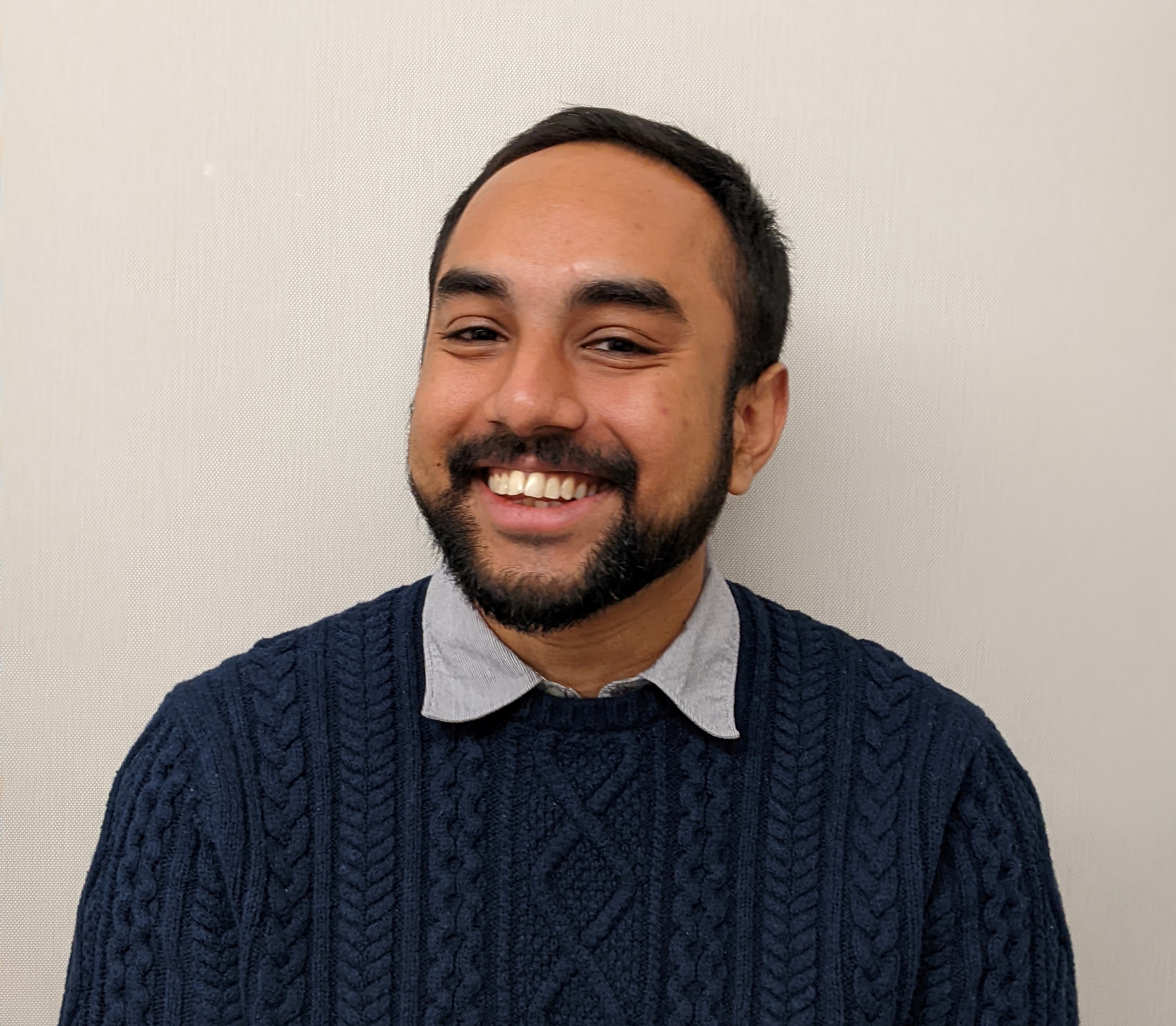
Assistant Professor / Faculty Fellow at the Center for Data Science, NYU.
Email: aahlad [at] nyu [dot] edu
About Me
I am a Faculty Fellow / Assistant Professor at the Center for Data Science at NYU. I obtained my PhD in Computer Science from the Courant Institute, NYU, where I was fortunate to be advised by Prof. Rajesh Ranganath. My dissertation received the Janet Fabri Prize for the most outstanding dissertation in NYU Computer Science, and my PhD was supported by an Apple Scholars in AI/ML Fellowship.
My research centers on adaptation: building AI systems that generalize beyond their training distribution, reason about the mechanisms that transfer across environments, and reveal what they rely on. I develop the representations and algorithms that make adaptation reliable, working toward the broader goal of reliable world models.
Representations and mechanisms. Generalization and shortcut learning — NuRD for out-of-distribution generalization with optimality guarantees, semantic corruptions for adjusting away unknown nuisances, and margin control for the shortcut learning that arises from gradient-based training with cross entropy. I also work on faithfulness and encoding in explanations, causal estimation with functional confounders, black-box causal estimation via meta-learning, and multimodal representation alignment.
Modeling and architectures. Long-context modeling, transformer dynamics and retrieval, and flow maps.
Impact on science. Equal learning for transportable clinical risk models, LODE for genome-wide association studies, and NuRD for new-particle detection on LHC data.
I’m eternally excited about new ideas and finding good applications for my work! Shoot me an email if you want to chat!
Selected Work
Attention and Compression is all you need for Controllably Efficient Language Models — In submission, 2026. CAT establishes a new frontier on the performance–throughput curve, with an adjustable throughput knob in a single trained model.
Flow Map Learning via Non-Gradient Vector Flow — ICLR 2026. Learns flow maps for few-step generative modeling, with a proven stationary-point guarantee.
How I learned to stop worrying and love StopGrads: Stationarity, Convergence, and a case study on Flow Map Learning — arXiv, 2026. A stopgrad regression principle that characterizes stationary points and convergence, and unlocks new stopgrad objectives for efficient flow map training.
Black Box Causal Inference: Effect Estimation via Meta Prediction — 2025. Learns whole estimation algorithms by framing causal estimation as dataset-level prediction.
Learning Is Not A Race: Improving Retrieval in Language Models via Equal Learning — EMNLP 2025. Equal learning improves retrieval by fixing how fast different features get learned.
Explanations that Reveal All through the Definition of Encoding — NeurIPS 2024. Defines encoding in explanations and gives STRIPE-X, a scalable way to detect it.
Contrasting with Symile: Simple Model-Agnostic Representation Learning for Unlimited Modalities — NeurIPS 2024. A multimodal alignment objective that captures higher-order interactions across any number of modalities, outperforming CLIP-based objectives by 12.5%.
Don’t Blame Dataset Shift! Shortcut Learning due to Gradients and Cross Entropy — NeurIPS 2023. Shortcut learning comes from the training objective, not just the data; margin control mitigates it.
OOD Generalization in the Presence of Nuisance-Induced Spurious Correlations — ICLR 2022. NuRD, with optimality guarantees for generalizing across populations.
Causal Estimation with Functional Confounders — NeurIPS 2020. LODE estimates causal effects when confounders are functions of the treatments, with an application to genome-wide association studies.
Selected Honors
- Janet Fabri Prize, Outstanding PhD Dissertation, NYU Computer Science, 2025
- Apple Scholars in AI/ML PhD Fellowship, 2022
- Top Reviewer, UAI 2022
- Trustworthy ML Rising Star, 2021
- MacCracken Doctoral Fellowship, NYU, 2018
News
-
May 2026: Gave talks at UCLA, UC Irvine, and UC Riverside on Making the most of your data for Reliable AI.
-
Apr 2026: Gave a talk at Fermilab on The Spectre of Spurious Correlations in OOD Generalization and Interpretability.
-
Mar 2026: Gave the same talk at the DBMI Seminar at Columbia.
-
Mar 2026: Extracting Representations in LLMs Robust to Distribution Shifts at the UCRL workshop at ICLR, about improved probing for high-level concepts in LLM representations.
-
Jan 2026: New paper Flow Map Learning Via Non-Gradient Vector Flow accepted at ICLR 2026, led by Mark Goldstein.
-
2025: My dissertation was awarded the Janet Fabri Prize, given to NYU CS’s most outstanding dissertation.
-
Nov 2025: Two papers at ML4H — Let the Experts Speak: Improving Survival Prediction & Calibration via Mixture-of-Experts Heads, led by Todd Morrill, and New-Onset Diabetes Assessment Using Artificial Intelligence-Enhanced Electrocardiography, led by Hao Zhang.
-
Nov 2025: New paper Attention and Compression is all you need for Controllably Efficient Language Models on building controllably efficient sequence models with attention primitives.
-
Nov 2025: New paper Learning Is Not A Race: Improving Retrieval in Language Models via Equal Learning at EMNLP Findings, improves feature learning in Transformers via a simple class of losses called E-losses.
-
Jan 2025: Black-box Causal Inference shows how to learn entire estimation algorithms by framing causal estimation as a meta-learning dataset-level prediction problem.
-
Dec 2024: Gave a tutorial at NeurIPS 2024 on Out-of-Distribution Generalization: Shortcuts, Spuriousness, and Stability, with Maggie Makar and Yoav Wald.
-
Oct 2024: Two papers at NeurIPS 2024, Explanations that reveal all through the definition of Encoding lead by Nhi and I, Multi-modal contrastive learning with SYMILE led by Adriel Saporta.
-
Aug 2024: Defended my PhD!
-
June 2024: Nuisances via Negativa accepted by TMLR; link.
-
Oct 2023: Gave a talk about OOD generalization in health at INFORMS.
-
Sept 2023: New paper accepted at NeurIPS 2023; link.
-
July 2023: The second SCIS workshop was a success at ICML 2023; link
-
April 2023: DIET was published at AISTATS; link.
-
July 2022: Organized the SCIS workshop at ICML 2022; website.
-
March 2022, Very happy to be a recipient of the Apple Scholars in AI/ML PhD Fellowship! announcement
-
March 2022, Updated version of NuRD on arxiv with code and improved results! link
-
January 2022, NuRD published at ICLR 2022 and work led by Mark Goldstein published at CLeaR 2022; link.
-
Oct’ 21, Named Rising Star by the Trustworthy ML initiative
-
June’ 21, New work on arxiv: What sort of predictive models come with performance guarantees under spurious correlations induced by a relationship between the label and some nuisance variables that are correlated on the covariates? Out-of-distribution Generalization in the Presence of Nuisance-Induced Spurious Correlations
-
Apr’ 21, Link to work at AISTATS, 2021; Led by Mukund Sudarshan: A new contrarian test statistic to use in CRTs to improve robustness to mis-specified covariate distributions. CONTRA: Contrarian statistics for controlled variable selection
-
Nov’ 20. Links to my work at NeurIPS 2020 along with punchlines (shoot me an email if these interest you!):
- General method for causal estimation from instrumental variables using only treatment process assumptions: General Control Functions for Causal Estimation from IVs
- Fundamental nonparametric assumptions for causal estimation using functional confounders which violate positivity: Causal Estimation with Functional Confounders
- Add-on differentiable loss to improve calibration of survival models allowing explicit trade-off with predictive quality: X-CAL: Explicit Calibration for Survival Analysis
Olds
I was an intern in the summer of 2019 in Adobe Research, San Jose working on bayesian attribution models for ad targeting. Previously, I worked as a Software Developer at DBMI, Columbia University. In 2017, I completed my MS in CS, also at NYU. I was introduced to causal inference in the Clinical Machine Learning group, where I worked with two amazing mentors, Prof. Uri Shalit and Prof. David Sontag. My fateful but fun undergrad was from IIT Madras, where I was enrolled in the EE department.